


.avif)
.avif)
.avif)

iPhone Text Effects: Tips and Tricks
September 21, 2026

Phones
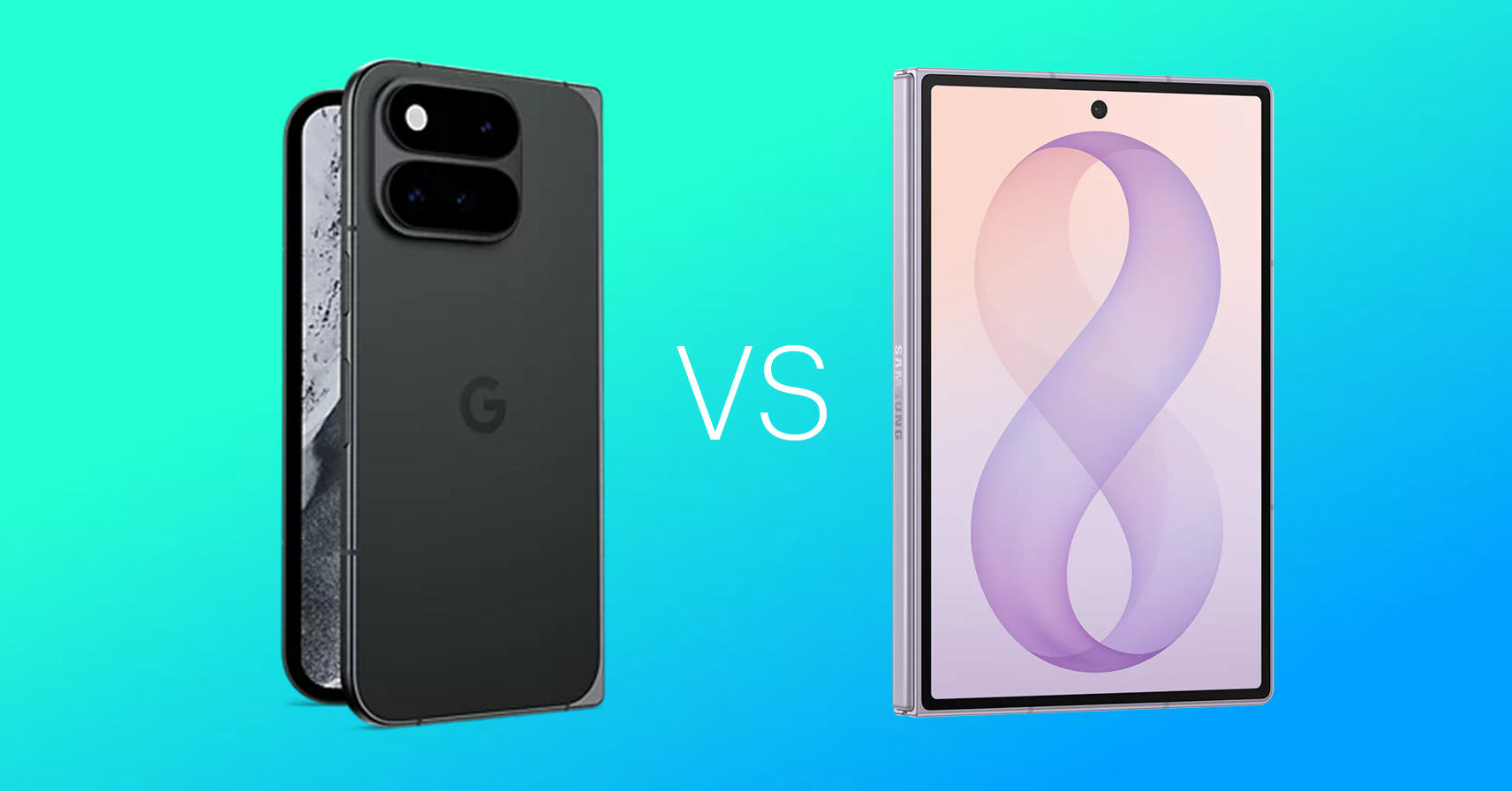

The two best foldable phones you can buy right now are the Google Pixel 11 Pro Fold and the Samsung Galaxy Z Fold8. Both launched in 2026, both cost over $1,800, and both make a serious case for being your next phone. But they're built around very different philosophies—and the right choice depends entirely on what you're actually going to use it for.
We've broken down every spec, feature, and real-world difference to help you decide. No carrier bias, just the facts.
Here’s a quick breakdown of how the two devices compare:
Google and Samsung have been trading blows in the foldable market since Samsung launched the original Galaxy Fold in 2019 and Google entered with the Pixel Fold in 2023. By 2026, both companies have hit a level of maturity where there's no bad choice here—only the wrong choice for *you*.
The Pixel 11 Pro Fold is Google's most refined foldable yet. At 239g, it's meaningfully lighter than its predecessor (the Pixel 10 Pro Fold came in at around 258g), and the 3,600-nit inner display is among the brightest on any foldable phone available. It runs Android 17 out of the box and leans hard into Gemini AI for everyday tasks.
The Samsung Galaxy Z Fold8 is Samsung's answer—a phone that's been refined over eight generations and carries the most capable multitasking software in the Android ecosystem. Samsung's One UI on a foldable is genuinely impressive, and Galaxy AI has matured into something more than a marketing bullet point.
Here's how they stack up across every dimension that matters.
The Pixel 11 Pro Fold's 239g weight is the headline number here. That's a significant drop from the Pixel 10 Pro Fold, and it's a phone you'll actually want to carry in your pocket all day. The folded dimensions—6.1 × 3 inches—give it a footprint close to a standard smartphone when closed.
The wider cover screen (6.5") is a deliberate Google design choice. The idea: you should be able to do most everyday tasks—texting, checking email, scrolling—without ever unfolding the phone. Samsung takes the opposite approach: the Z Fold8's cover display is a narrower 5.5 inches, closer to a traditional phone shape when closed.
On weight, Samsung actually has the edge: the Galaxy Z Fold8 comes in at 201g, 38 grams lighter than the Pixel 11 Pro Fold's 239g. If pure heft is what you care about, the Z Fold8 is the lighter phone to carry—even though the Pixel is the lighter of the two Pixels.
Color options: the Pixel 11 Pro Fold comes in Olive and Obsidian—understated and premium. The Galaxy Z Fold8 offers more variety, with Graphite, Cream, Lavender, and Pistachio.
The hinge is the most important mechanical component on any foldable—it's what separates a phone that lasts three years from one that develops a creak at month eight.
Google's hinge on the Pixel 11 Pro Fold carries forward the flat-fold design that allows the phone to close completely flat, with no gap. That's better for pocket carry and reduces stress on the inner display over time.
Samsung has eight generations of hinge refinement behind the Z Fold8, and it shows—the phone folds down to a confirmed 9.7mm thick.
On water resistance: the Pixel 11 Pro Fold carries an IP68 rating—full dust and water resistance up to 1.5 meters for 30 minutes.
IP68 on a foldable is genuinely impressive. Most foldables have historically topped out at IPX8 or IP48 because the hinge gap makes full dust sealing difficult. If you're hard on your phones, the Pixel's IP68 rating is a meaningful advantage.
No foldable phone has a completely invisible crease—that's just physics. But the gap between the best and worst has narrowed considerably.
The Pixel 11 Pro Fold's inner display uses Google's Super Actua Flex panel, which carries a pre-applied screen protector from the factory. The crease is visible when the screen is off but largely disappears during normal use—especially at 3,600-nit brightness levels where the display itself draws your eye.
The Pixel 11 Pro Fold's 6.5" Super Actua cover screen is the widest cover display Google has shipped on a foldable. It's bright, responsive, and genuinely usable as a standalone smartphone screen for most tasks.
The 8" Super Actua Flex inner display is where the Pixel 11 Pro Fold makes its biggest statement. That 3,600-nit peak brightness is among the highest on any foldable phone—and it matters more than you'd think.
Here's the real-world difference: watching HDR content on a 3,600-nit display in a bright room is a genuinely different experience than watching on a 1,500-nit panel. Highlights pop, shadow detail holds, and you're not squinting to see what's happening on screen.
The Pixel 11 Pro Fold shoots with a 48MP wide camera. Samsung's main sensor on the Z Fold8 is confirmed at 50MP—a slightly higher resolution, but megapixels aren't the whole story, especially with Google's computational photography pipeline behind the Pixel's sensor.
Google's approach: capture a good image, then make it better in processing. The Tensor G6 chip handles noise reduction, HDR blending, and portrait edge detection in real time. The result is photos that look natural and consistent across lighting conditions.
Samsung's approach: give you more raw data (higher resolution sensor) and let ProVisual Engine and Galaxy AI handle the processing. Samsung's output tends toward more saturated, punchy colors—which many users prefer, but which diverges from what you'd see with your own eyes.
Neither approach is wrong. It's a matter of taste.
The Pixel 11 Pro Fold carries a 10.5MP ultrawide and a 10.8MP telephoto.
The Samsung Galaxy Z Fold8's ultrawide is confirmed at 50MP—but notably, Samsung's spec sheet lists no telephoto lens at all on the Z Fold8, a step back from the Z Fold7's 10MP 3x telephoto. If a dedicated zoom lens matters to you, that's a real, non-cosmetic point in the Pixel's favor: the 11 Pro Fold is the only one of the two with a true telephoto camera.
Google's telephoto performance has been a consistent strength across the Pixel lineup. Even at high zoom levels, the Tensor G6's Super Res Zoom processing holds detail well. Without a dedicated zoom lens, the Z Fold8 will rely on digital crop and Samsung's ProVisual Engine for anything beyond its native focal lengths.
Both phones offer strong video stabilization. Google's Video Boost (if confirmed for the Pixel 11 Pro Fold) processes video through Google's data centers for enhanced quality—a feature with no direct Samsung equivalent.
The under-display inner camera on foldables remains a weak point across the industry. Both phones include it for video calls when the phone is unfolded flat, but neither company leads here—expect softer results than the rear cameras.
The Pixel 11 Pro Fold runs on Google's Tensor G6. The Samsung Galaxy Z Fold8 runs on Qualcomm's Snapdragon 8 Elite Gen 5.
Here's the honest take on Tensor vs. Snapdragon: Snapdragon chips have historically led in raw GPU performance and gaming benchmarks. If you're running graphically intensive games at max settings, a Snapdragon-powered device has typically had the edge. Tensor G6 has closed that gap compared to earlier Tensor generations, but it's worth acknowledging the trade-off.
Where Tensor G6 genuinely leads: on-device AI processing. The chip is purpose-built to run Gemini models locally, which means faster responses, better privacy (processing happens on the phone, not in the cloud), and AI features that work even without a data connection.
The Pixel 11 Pro Fold also ships with 16GB of RAM—enough to keep a dozen apps in memory simultaneously without the phone needing to reload them. The Samsung Galaxy Z Fold8 starts at 12GB on its base configuration and steps up to 16GB on higher storage tiers—matching the Pixel at the top end, but starting lower.
The Pixel 11 Pro Fold packs a 4,750 mAh battery. That's a meaningful step up from the Pixel 10 Pro Fold's 4,650 mAh, and it powers two displays—so battery management matters.
The Samsung Galaxy Z Fold8 packs a slightly larger 4,800 mAh battery—a modest edge over the Pixel on paper, though real-world life depends heavily on how each phone's display and chip manage that capacity.
Real-world battery life on foldables depends heavily on how you use them. If you're spending most of your time on the inner display at high brightness, expect more drain than a standard slab phone. The Pixel 11 Pro Fold's 3,600-nit display is power-hungry when pushed—though LTPO refresh rate scaling helps offset that during lighter use.
The Pixel 11 Pro Fold ships with Android 17—the latest version of Android, arriving first on Pixel devices as it always does. Google has committed to seven years of OS updates and security patches for the Pixel 11 Pro Fold, which means this phone stays current through 2033.
Samsung has matched Google's seven-year update commitment on recent flagship devices.
This is where the two phones diverge most sharply—and where the "gimmick or not" question deserves a real answer.
The honest answer to "gimmick or not": both platforms have features that will change how you use your phone daily, and features you'll try once and forget. Gemini's advantage is depth of integration across Google's ecosystem. Galaxy AI's advantage is breadth—more features across more apps, especially for Samsung-specific workflows.
This is Samsung's clearest win. One UI on the Galaxy Z Fold8 supports three apps simultaneously on the inner display, a taskbar that mirrors a desktop dock, and App Pairs that let you save two-app combinations as a single shortcut.
The Pixel 11 Pro Fold's multitasking has historically been limited to two apps in split-screen.
If you're buying a foldable specifically to work across multiple apps at once—reviewing a document while on a video call while checking Slack—Samsung's multitasking implementation is more capable.
Both phones are available through major carriers—AT&T, T-Mobile, and Verizon—and carrier deals can significantly reduce what you pay out of pocket. Trade-in promotions at launch can bring the effective cost down substantially, depending on your current device and which carrier you're switching to or staying with.
No doubt about it: the best deals on flagship foldables move fast and vary by carrier. The specifics change frequently enough that citing a number here would likely be outdated within weeks.
The smarter move: use Navi's free Phone Deal Finder to compare current trade-in values and carrier promotions across all major carriers at once. It's free, unbiased, and pulls from over 3 million deals analyzed daily.
So which one should you actually buy? It comes down to what you value most.
If you're deep in the Google ecosystem—Gmail, Google Photos, Google Docs, YouTube—the Pixel 11 Pro Fold is the clear pick, since Gemini AI ties all of it together in ways that feel genuinely integrated rather than bolted on. It's also the stronger choice if camera quality is your top priority: Google's computational photography consistently produces natural, accurate images, and the Tensor G6 pipeline is purpose-built for it. The Pixel is also the only one of the two with a true telephoto lens—Samsung dropped dedicated zoom entirely on the Z Fold8—so if a zoom camera matters to you, that's a real point in its favor. Water resistance is another differentiator: the Pixel 11 Pro Fold carries an IP68 rating, and full dust and water resistance on a foldable is still relatively rare and genuinely useful. It also has the brightest foldable display available, with 3,600 nits on the inner screen offering a meaningful real-world advantage for outdoor use and HDR content, and it gets Android 17 first, with seven years of guaranteed updates.
The Samsung Galaxy Z Fold8, on the other hand, is the better choice if multitasking is your primary use case—three apps running simultaneously, App Pairs, and a mature taskbar make it the more capable productivity machine. It's also the lighter foldable: at 201g, it's 38 grams lighter than the Pixel 11 Pro Fold, and it edges out the Pixel on battery capacity too (4,800 mAh vs. 4,750 mAh). If you want maximum customization, One UI gives you more control over your foldable experience than stock Android does, and if you prefer punchier, more saturated photos straight out of the camera with no editing required, Samsung's output tends to deliver that. It's also the natural pick if you're already living in the Samsung ecosystem—Galaxy Watch, Galaxy Buds, Samsung TV—since that integration is real and worth something.
Neither phone is perfect. The Pixel 11 Pro Fold's multitasking lags behind Samsung's, it lacks Samsung's weight and battery-capacity edge, and Tensor G6 trails Snapdragon in raw gaming performance.
If you're a Google person buying your first foldable, the Pixel 11 Pro Fold is the way to go. If you're a Samsung loyalist or a power user who lives in split-screen, the Z Fold8 is worth checking out.
The Google Pixel 11 Pro Fold and Samsung Galaxy Z Fold8 are both exceptional phones—and genuinely different enough that the right answer isn't the same for everyone.
The Pixel 11 Pro Fold wins on confirmed peak display brightness, its dedicated telephoto lens, camera processing, IP68 water resistance (pending Samsung confirmation), and Gemini AI integration. The Samsung Galaxy Z Fold8 wins on weight (201g vs. 239g), battery capacity, main/ultrawide sensor resolution, multitasking depth, and customization.
Before you buy either one, it's worth seeing what carrier deals are available for your specific trade-in device. Prices at MSRP are one thing—what you actually pay after trade-in and carrier promotions is often a very different number.
If you're in the Google ecosystem and want the best computational photography on a foldable, yes—the Pixel 11 Pro Fold is backed by a strong camera system, 3,600-nit display, IP68 water resistance, and seven years of updates. Whether the price makes sense for *you* depends on what carrier deal you can get. Use the Phone Deal Finder to see your actual cost after trade-in.
Samsung Galaxy Z Fold8, no doubt about it. One UI supports three simultaneous apps on the inner display, App Pairs shortcuts, and a taskbar that works like a desktop dock. The Pixel 11 Pro Fold's multitasking has historically been limited to two apps in split-screen.
Some of both, honestly. Features like Live Translate, Writing Assist, and AI photo editing are genuinely useful in daily use. Others are impressive demos you'll try once. The same is true of Gemini on the Pixel side. The difference: Gemini integrates more deeply across Google's ecosystem, while Galaxy AI covers more Samsung-specific workflows. Neither is purely a gimmick.













.png)