


.avif)
.avif)
.avif)

iPhone Text Effects: Tips and Tricks
October 20, 2026

Coverage
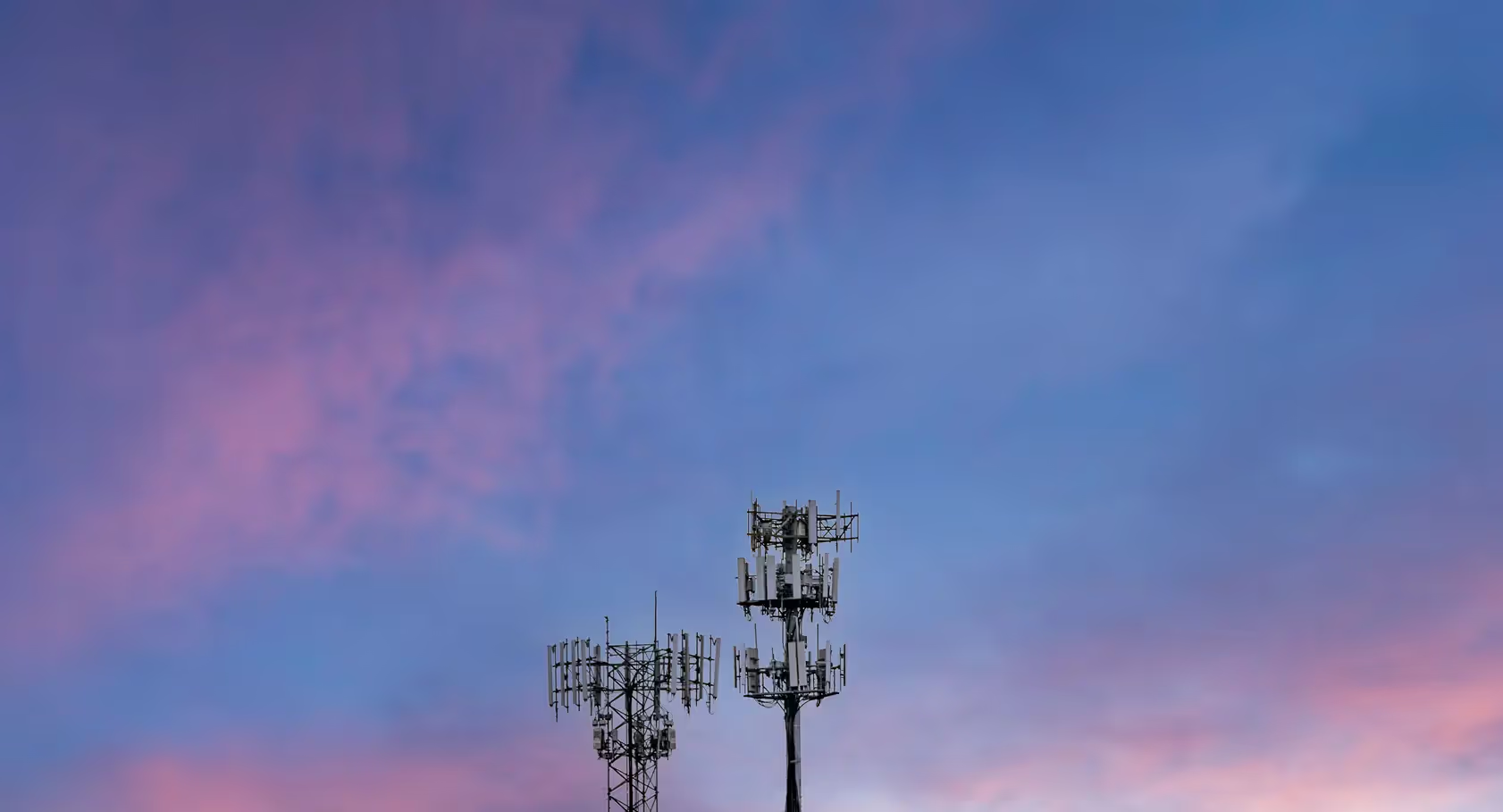

Like every other small carrier, or MVNO, Spectrum Mobile makes use of a larger network to provide service to its customers—in this case, Verizon.
That's good news for Spectrum Mobile customers, since Verizon offers the best combined 4G and 5G coverage in the country. Read on as we explore the Spectrum Mobile coverage map and tell you how to make the most of it.
NOTE: In August 2026, Spectrum completed its acquisition of Cox—along with its cell phone brand, Cox Mobile. If you’re looking for Cox Mobile plans, you won’t find any, and will likely be redirected to Spectrum Mobile ones.
Spectrum Mobile runs on the same network—Verizon—that Cox Mobile ran on, which offers reliable 4G and 5G coverage from coast to coast. Better still, Spectrum Mobile offers similarly inexpensive plans, with its entry-level Unlimited plan starting at $0/month for the first year.
{{takeaways}}
Spectrum Mobile requires an active Spectrum Internet subscription. You can't sign up without it. If you cancel your home internet service, you'll need to find a new mobile provider.
WiFi Access Points supplement your cellular coverage. Spectrum maintains over 48 million WiFi hotspots across the U.S.—more on those in a dedicated section below.
You're an MVNO customer, not a Verizon postpaid customer. Same towers, but there are real-world differences—especially during peak congestion periods.
Yes. All Spectrum Mobile plans include 5G access—but not all 5G is the same. There are two distinct tiers, and understanding the difference matters when you're choosing a plan.
5G Nationwide is built on low-band spectrum. It covers a broad geographic area—most of the country, in fact—and delivers a modest speed improvement over 4G LTE. Think of it as a wider road with slightly better traffic flow. You'll see it in cities, suburbs, and even many rural areas.
5G Ultra Wideband is Verizon's high-performance 5G, using mid- and high-band frequencies. It delivers dramatically faster speeds and ultra-low latency—we're talking download speeds that can hit 1 Gbps or more in ideal conditions. The catch: it's concentrated in dense urban areas, stadiums, airports, and transit hubs. It doesn't blanket entire cities.
Verizon has expanded Ultra Wideband to 40+ major U.S. markets. If you're in one of these cities, Unlimited Plus gives you access to the fastest tier of 5G Spectrum Mobile offers:
Albuquerque, Atlanta, Austin, Baltimore, Boston, Charlotte, Chicago, Cincinnati, Colorado Springs, Columbus, Dallas, Denver, El Paso, Fort Worth, Fresno, Houston, Indianapolis, Jacksonville, Kansas City, Las Vegas, Long Beach, Los Angeles, Louisville, Memphis, Mesa, Miami, Milwaukee, Minneapolis, Nashville, New York, Oklahoma City, Omaha, Philadelphia, Phoenix, Pittsburgh, Portland, Raleigh, Sacramento, San Antonio, San Diego, San Francisco, San Jose, Seattle, St. Louis, Tampa, Tucson, Virginia Beach, Washington, D.C.
This is one of Spectrum Mobile's most underrated advantages—and one that most competitors don't offer at all.
Spectrum maintains over 48 million WiFi Access Points across the U.S. Spectrum Mobile devices connect to these hotspots automatically, offloading data from the cellular network to WiFi without you doing anything. That means faster speeds, less cellular data consumption, and better indoor coverage in places where cell signals tend to struggle.
Here's why this matters in practice: indoor coverage gaps. Buildings—especially older ones—can block cellular signals. WiFi Access Points fill those gaps in Spectrum-served areas.
Data savings. If you're on the By the Gig plan, automatic WiFi offloading means you're using less of your paid cellular data. That's real money.
Congestion relief. During peak hours when the cellular network is busy, WiFi Access Points give you an alternative path to connectivity.
No other major Verizon MVNO—including Visible—offers this kind of supplemental WiFi layer. It's a genuine differentiator for Spectrum Mobile, especially if you live or work in areas with dense Spectrum infrastructure.
The practical limitation: WiFi Access Points are concentrated in areas where Spectrum provides cable internet service. If you're in a region Spectrum doesn't serve, this benefit is minimal. And like any public WiFi, performance depends on how many people are connected at a given time.
Spectrum Mobile uses Verizon’s network to provide 4G and 5G coverage to its customers. Verizon’s 4G network is the best in the country, while its 5G network is small but growing. Whether you’re in a major city, the suburbs, or even some rural areas, you can expect strong coverage with Spectrum Mobile.
One caveat: Verizon tends to prioritize its own subscribers during times of network congestion; if it’s especially busy, Spectrum Mobile customers may experience slightly slower speeds than Verizon customers.
Spectrum Mobile reliance on Verizon’s network translates to excellent 4G LTE coverage for its customers. Verizon’s 4G network is the most wide-reaching in the country, and Spectrum Mobile subscribers have the benefit of tapping directly into it. This includes metropolitan, suburban and rural areas throughout the United States.
Spectrum Mobile customers with 5G-enabled devices can access Verizon’s growing 5G network, which includes two types of service:
To experience the benefits of Spectrum 5G, you’ll need a compatible phone and be in a covered area.
Spectrum Mobile is just one of the many prepaid carriers vying for your business, a crowded field that also includes fellow MVNOs like Cricket Wireless and Mint Mobile. So how does Spectrum Mobile’s coverage stack up against these brands?
The handy chart below can help give you a sense of how Spectrum Mobile’s national network compares to a couple of its foremost competitors. Note that Mint Mobile uses T-Mobile’s system of networks, while Cricket uses AT&T’s.
Spectrum Mobile offers a few straightforward unlimited plan options, all of which require you to be a Spectrum Internet customer. These include the entry-level Spectrum Unlimited plan, which features 30GB of premium cellular data and a 5GB mobile hotspot allowance for $0/month for the first year, $40/month thereafter; the mid-tier Spectrum Unlimited Plus, which offers 50GB of premium cellular data a month, a 10GB mobile hotspot allowance, and an early phone upgrade option for $10/month for the first year, $50/month thereafter; and the premium Unlimited Plus Premium, which features unlimited premium cellular data, a generous 50GB mobile hotspot allowance, a free smartwatch data plan, and an early phone upgrade option, for $20/month for the first year, $60month thereafter.
All plans include nationwide 5G access, free mobile hotspot usage (at reduced speeds), and no contracts. Pricing is competitive, especially for Spectrum Internet customers looking to bundle services.
{{cards-1}}
No doubt about it—Spectrum Mobile is one of the better-value options if you're already a Spectrum Internet customer. You get Verizon's extensive 4G LTE and 5G network, access to 48 million WiFi Access Points, and pricing that's roughly half of what Verizon charges its own postpaid customers.
The trade-offs are real, though. Deprioritization during congestion is a genuine consideration for heavy users in dense urban areas. The Spectrum Internet requirement locks out anyone who doesn't already have—or want—Spectrum home internet. And Ultra Wideband 5G, while impressive where it exists, is far from ubiquitous even in the cities where it's available.
If you're weighing Spectrum Mobile against other options—Visible, Mint Mobile, Cricket Wireless, or even going directly with Verizon—the right answer depends on your location, your usage habits, and whether you already have Spectrum Internet at home.
Navi's Plan Finder is free and unbiased. It compares Spectrum Mobile against dozens of carriers based on your actual needs—coverage in your area, how much data you use, how many lines you need. Try it and get personalized results in a matter of seconds.
Since Spectrum Mobile uses Verizon’s towers, it has excellent nationwide 4G LTE and 5G coverage serving more than 99% of the U.S. population. Though its 5G coverage is less far-reaching than that of AT&T and T-Mobile, Verizon 5G network speeds are among the fastest.
Spectrum Mobile does not use its own cell phone towers. Instead, it operates on Verizon's network towers and uses its own WiFi hotspots to provide service.
Spectrum Mobile is a part of Charter Communications and offers 4G and 5G service through Verizon’s network and its own WiFi hotspots. It’s a more affordable alternative to major carriers since it leases Verizon’s network instead of running its own. Just keep in mind—you need to be a Spectrum home internet customer to access its savings.












.png)